
ETOM Milestone-Conference 2026
21–23 October 2026 in Trenčin/Slovakia
The conference held within the official program of European Capital of Culture (ECOC) Trenčin 2026, invites scholars, architects, planners, educators, researchers, and policymakers to reflect on how modern architecture, landscape, and planning visions can be reinterpreted and reactivated in the twenty-first century. The conference seeks an interdisciplinary dialogue across time and scale—linking architectural form with territorial context, and historical experience with contemporary and future scenarios. See you on 21–23 October in Trenčin …
ETOM Milestone-Conference 2026
21–23 October 2026 in Trenčin/Slovakia
Day 1 • Day 2 • Day 3 • Register
Outline of the Conference
Modernism Revisited 2026, held within the official program of European Capital of Culture (ECOC) Trenčin 2026, invites scholars, architects, planners, educators, researchers, and policymakers to reflect on how modern architecture, landscape, and planning visions can be reinterpreted and reactivated in the twenty-first century. The conference seeks an interdisciplinary dialogue across time and scale—linking architectural form with territorial context, and historical experience with contemporary and future scenarios. This conference is organised by the Jaromir Krejcar Society and the ETOM-NEB-Lab partnered with DOCOMOMO Slovakia.
Modernism—both as a historical movement and as an continuous architectural, technological, and cultural layer—continues to shape how we build, inhabit, and imagine the world. Emerging from diverse political, climatic, and cultural contexts—from liberal democracies to state-planned economies—in the past century generated a wide spectrum of approaches to architecture, urbanism, and life.
Today, these multiple legacies face new realities: ecological transitions, demographic shifts, and the transformation of once-public infrastructures and institutions. While mere technocratic, aesthetically formalistic and ideologically dogmatic conceptions of Modernism did not survive. The theories, practices and ideologies of modern thinking continue to shape our realities, while being constantly challenged and questioned. In order to challenge the current multicrisis, the humanist, emancipatory and social aspects need to be considered. The legacy of Modernism lives on as a structural framework to be filled in with contemporary ideas.

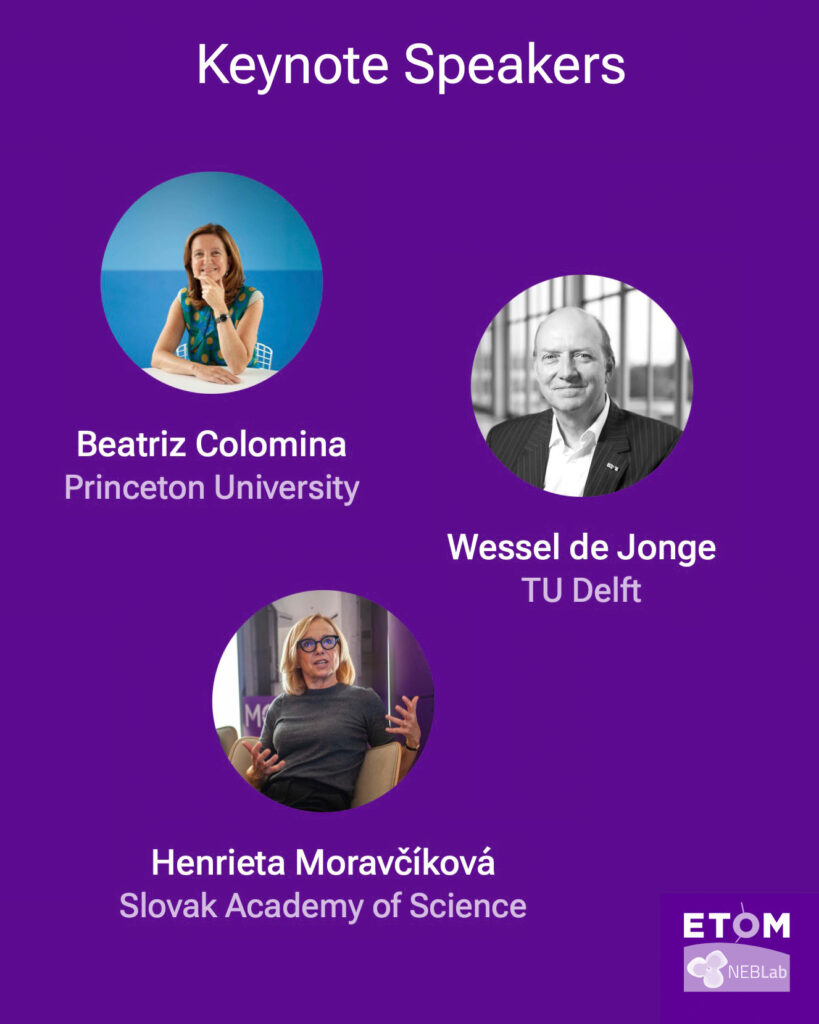
Keynote speakers
- Beatriz Colomina, Princeton University
- Henrieta Moravčíková, Slovak Academy of Science
- Wessel de Jonge, TU Delft
Venue & Updates
The Okruhový dom armády (ODA) is the main venue of the Modernism Revisited 2026 conference. Designed by Ivan Kočan, Eduard Horváth and Dušan Bálent (1977–1978, completed 1985), the building is a distinctive example of late modernist architecture with brutalist influences in Slovakia.
The conference is accompanied by the exhibition Machnáč at 1:1 Scale, with translocated elements of the iconic Health Spa House in Trenčianske Teplice designed by Jaromír Krejcar.
ODA – Officers‘ House of the Army (Posádkový klub)
Hviezdoslavova 205
911 01 Trenčín / Slovakia
The detailed program can be checked here:
modernismrevisited2026.com
Program 21/10/26—23/10/26, ODA
MODERNISM REVISITED
European Triennale of Modernism – Milestone Conference
Trenčín 2026
Day 1 • Day 2 • Day 3 • Register
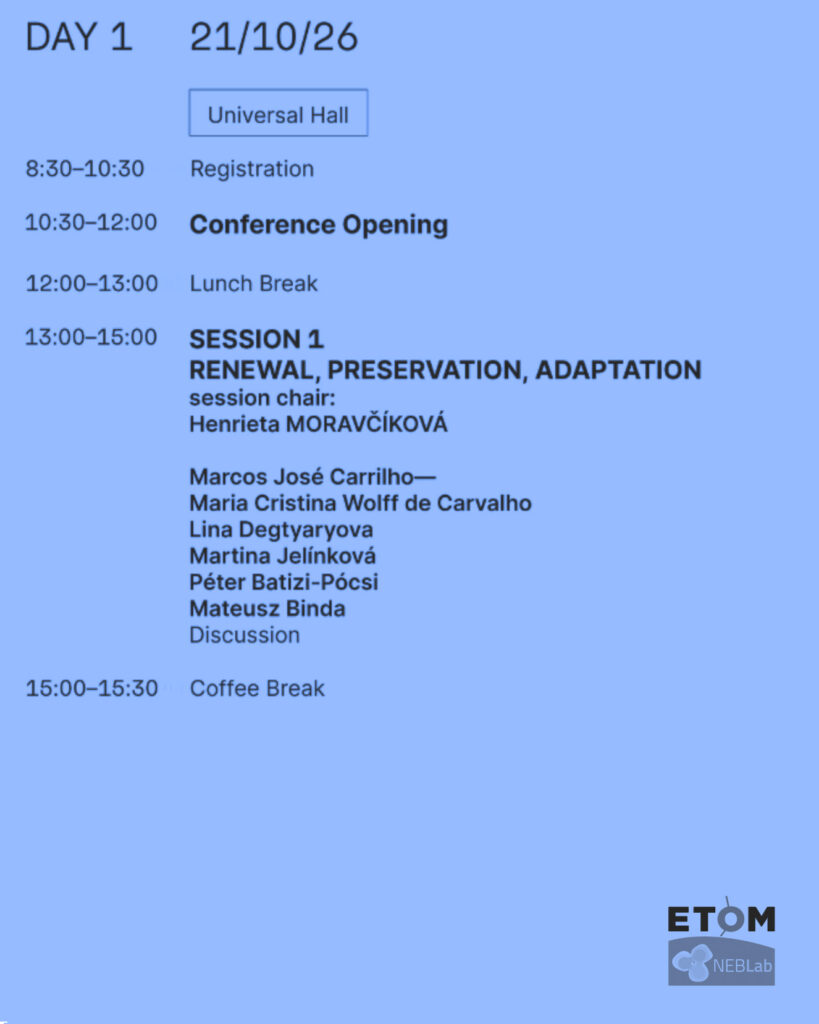
DAY 1 – 21/10/26
- 08:30–10:30 Registration
- 10:30–12:00 CONFERENCE OPENING
- 12:00–13:00 Lunch Break
- 13:00–15:00 TY1 – RENEWAL, PRESERVATION, ADAPTATION (Universal Hall)
session chair: Henrieta MORAVČÍKOVÁ- Marcos José Carrilho, Maria Cristina Wolff de Carvalho: Adaptive Reuse and the Reinvention of the Pacaembu Stadium, São Paulo
- Lina Degtyaryova: A Century of the Malé Galago Quarter in Uzhhorod: Three Stages of Transformation
- Martina Jelínková: Continuity of Scars: Reinventing Preservation Strategies through the Works of K. Chudomelka and F. Minissi
- Péter Batizi–Pócsi: Type and extension, Typological analysis of Bertalan Árkay’s villas from the 1930s in light of a contemporary design intervention
- Mateusz Binda: Reinventing the ephemeral: Reinterpretation as an alternative to physical reconstruction of modernist pavilion architecture
- Discussion
- 15:00–15:30 Coffee Break
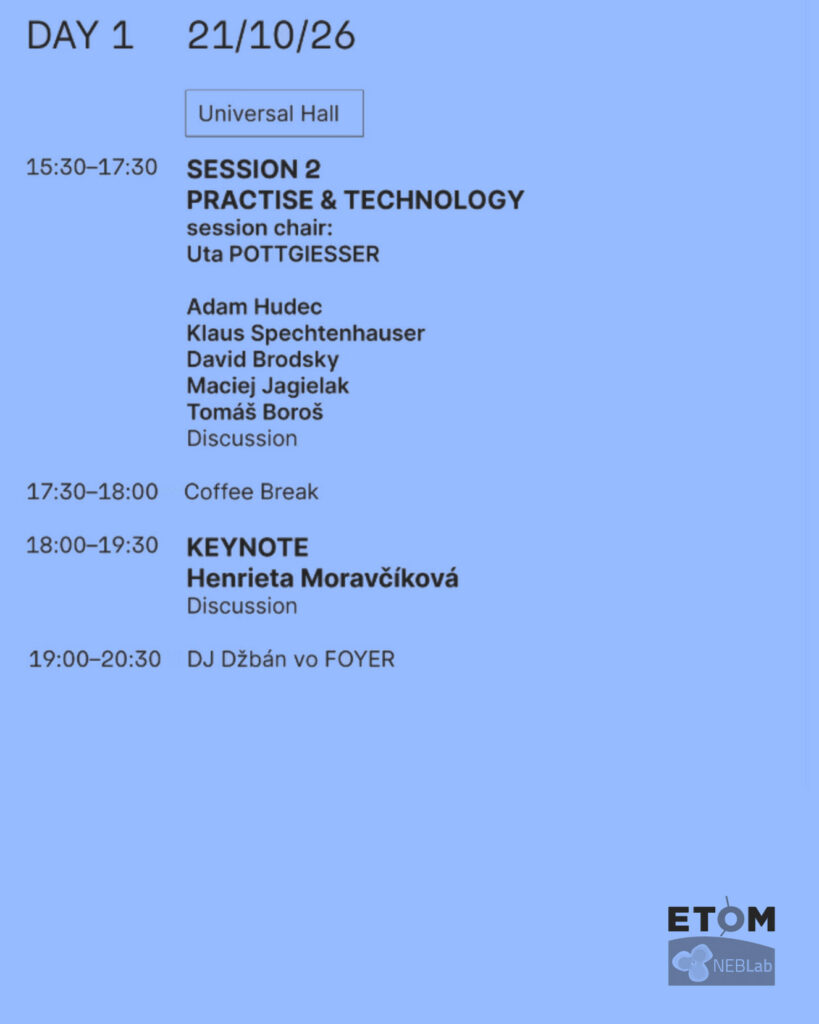
- 15:30–17:30 S1 – PRACTICE & TECHNOLOGY (Universal Hall)
session chair: Uta POTTGIESSER- Klaus Spechtenhauser: ‚Ein Haus WOBA‘
- Adam Hudec: Towards Bio–Maintenance: Living with the Legacy of modernist outer Surfaces
- David Brodsky: Unfinished House: A Gesture in Time
- Maciej Jagielak: Pavillon de l’Esprit Nouveau—the modern Icon made of Straw. A critical Reflection on bio–based Materials
- Tomáš Boroš: Values beyond Ideology. Preserving the Values of Modern Architecture: The Renewal of the Košice City Hall Building as a Case Study
- Discussion
- 17:30–18:00 Coffee Break
- 18:00–19:00 #1 HLAVNÁ PREDNÁŠKA / KEYNOTE LECTURE
- HENRIETA MORAVČÍKOVÁ: Slovak variant of modernism? Revisiting the post–war architecture in Slovakia
- 19:00–19:30 Discussion
- 19:00–20:30 DJ Džbán
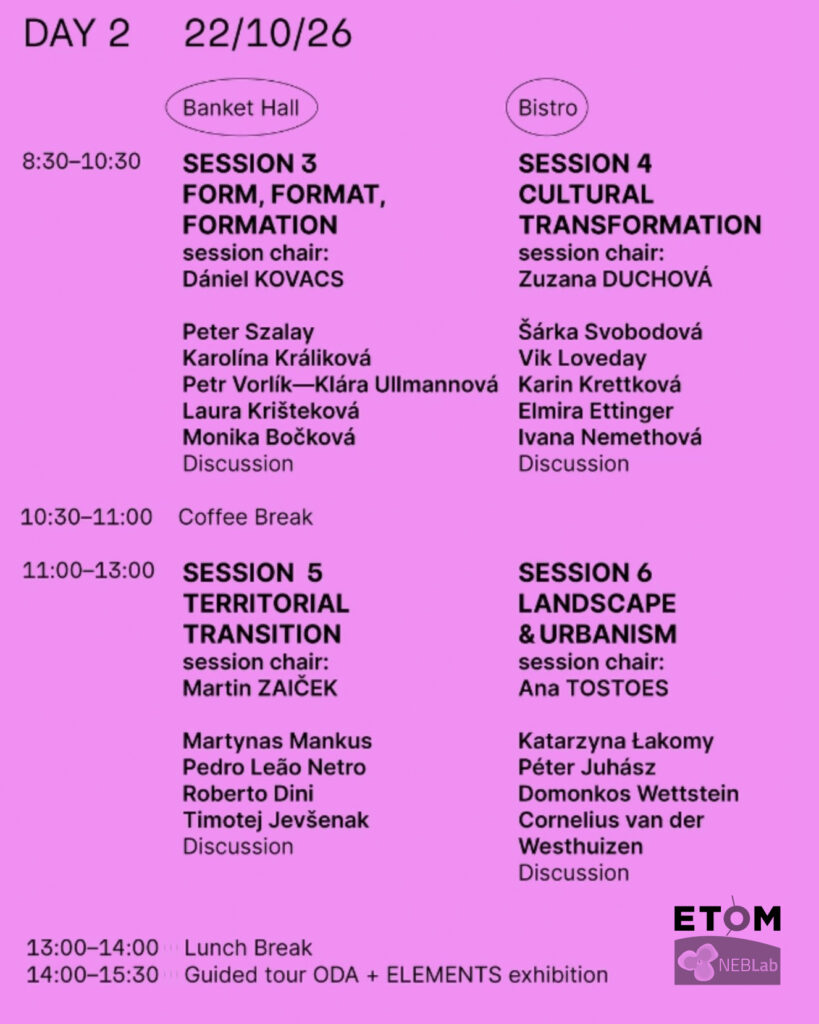
DAY 2 – 22/10/26
- 08:30–10:30: TY3 – FORM, FORMAT, FORMATION (Banket Hall)
session chair: Dániel KOVÁCS- Peter Szalay: Embodied Energy and Post–War Modernism: Monitoring Architectural Heritage in Slovakia
- Karolína Králiková: From Socialist Retail to Architectural Heritage: The Typology of Department Stores in Post–War Slovakia
- Petr Vorlík, Klára Ullmannová: Modernism trapped between standardization and socialist realism
- Laura Krišteková: The monuments of healthcare: how modernism influenced the architectural form and adaptability of centralized hospital
- Monika Bočková: Hospitality infrastructure: Postwar Hotel Architecture in Slovakia
- Discussion
- 08:30–10:30: S3 – CULTURAL TRANSFORMATION (Bistro)
session chair: Zuzana PASTIRČÁK DUCHOVÁ- Šárka Svobodová: ON ALERT: curatorial practice as an engaged act
- Vik Loveday: From obsolescence to cultural heritage: Revisiting Slovak monumental artworks produced during the era of ’normalisation‘
- Karin Krettková: The Ugly Modernism, or Where Did the Ornament Go?
- Elmira Ettinger: Preserving 20th–century Ukrainian monumental art through reinterpreting a contested legacy and popularizing unknown history
- Ivana Nemethová: Reinterpreting Modernism through a Gender–Sensitive Lens
- Discussion
- 10:30–11:00 Coffee Break
- 11:00–13:00: T2 – TERRITORIAL TRANSITION (Banket Hall)
session chair: Martin ZAIČEK- Martynas Mankus: Typology Repurposed: The Pedestrian Street as Late Soviet Urban Prototype
- Pedro Leão Neto: Repurposing the Modernist Swimming Pool: Typology and Remodeled Topography in Álvaro Siza’s Coastal and Park Landscapes
- Roberto Dini: Rethinking alpine legacies
- Timotej Jevšenak: Topography After Disaster: Slovenska plaža (Budva, 1980–84) and the Remodeling of Yugoslav Coastal Tourism
- Discussion
- 11:00–13:00: T1 – LANDSCAPE & URBANISM (Bistro)
session chair: Ana TOSTÕES- Katarzyna Łakomy: Greenery and modernism architecture – shaping historical and contemporary spatial narratives based on examples from Poland
- Péter Juhász: Landscape as Political Infrastructure: Ideologies and Regimes of Visibility in the Third Reich and the Soviet Union
- Domonkos Wettstein: „Landscape as monumental sculpture“ – ecological crisis effects and civil society activities in the reconceptualization of modern landscapes in Hungary
- Cornelius van der Westhuizen: The polysemy of demolition and spatial appropriation
- Discussion
- 13:00–14:00 Lunch Break
- 14:00–15:30 ODA & ELEMENTS – Guided Tour
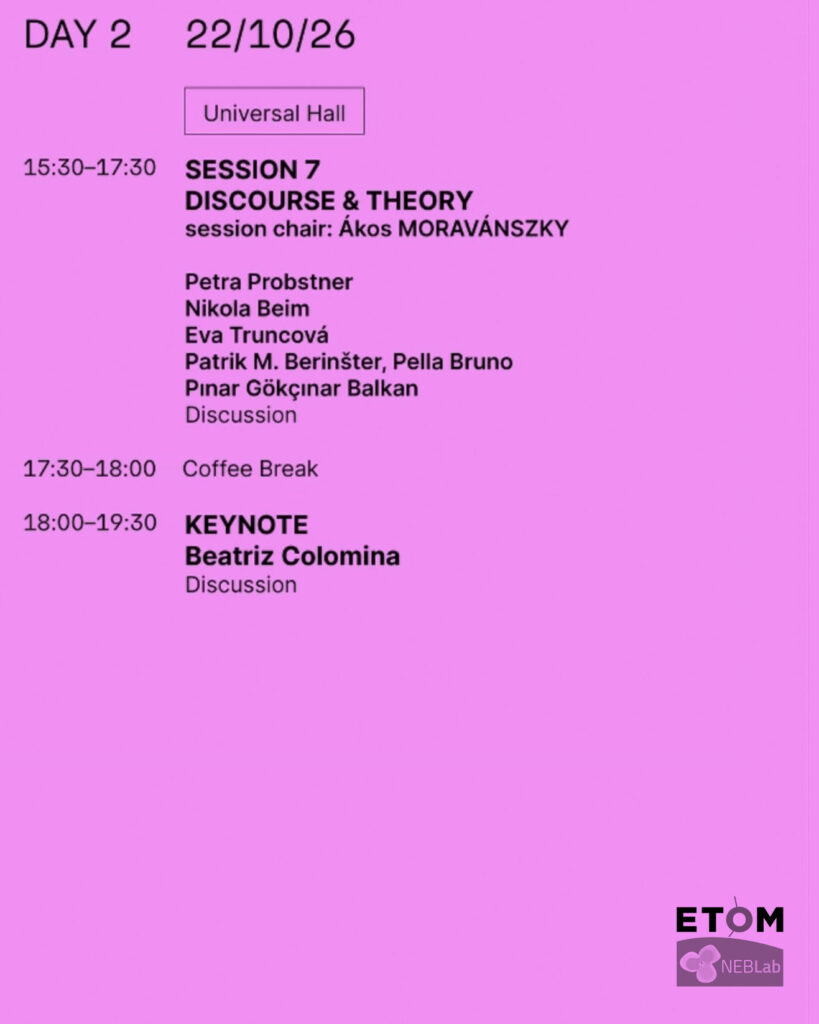
- 15:30–17:30 S4 – DISCOURSE & THEORY (Universal Hall)
session chair: Ákos MORAVÁNSZKY- Petra Probstner: Building from Nothing: Restorative Cartography against the Modernist Tabula Rasa
- Nikola Beim: Modern Denkmalpflege in Central Europe
- Eva Truncová: Beyond Authorial Meaning: Authorship and the Plural Interpretation of Modernist Architecture
- Patrik M. Berinšter, Bruno Pella: Typology and Its Theoretical Roots: Reevaluating the Modernist Approach
- Pınar Gökçınar Balkan: Silent Intelligence: Re–engaging the Heritage of Early Republican Modernism through Digital Strategies at Pembe Köşk House Museum
- Discussion
- 17:30–18:00 Coffee Break
- 18:00–19:00 #2 HLAVNÁ PREDNÁŠKA / KEYNOTE LECTURE
BEATRIZ COLOMINA: Form Follows Bacteria - 19:00–19:30 Discussion
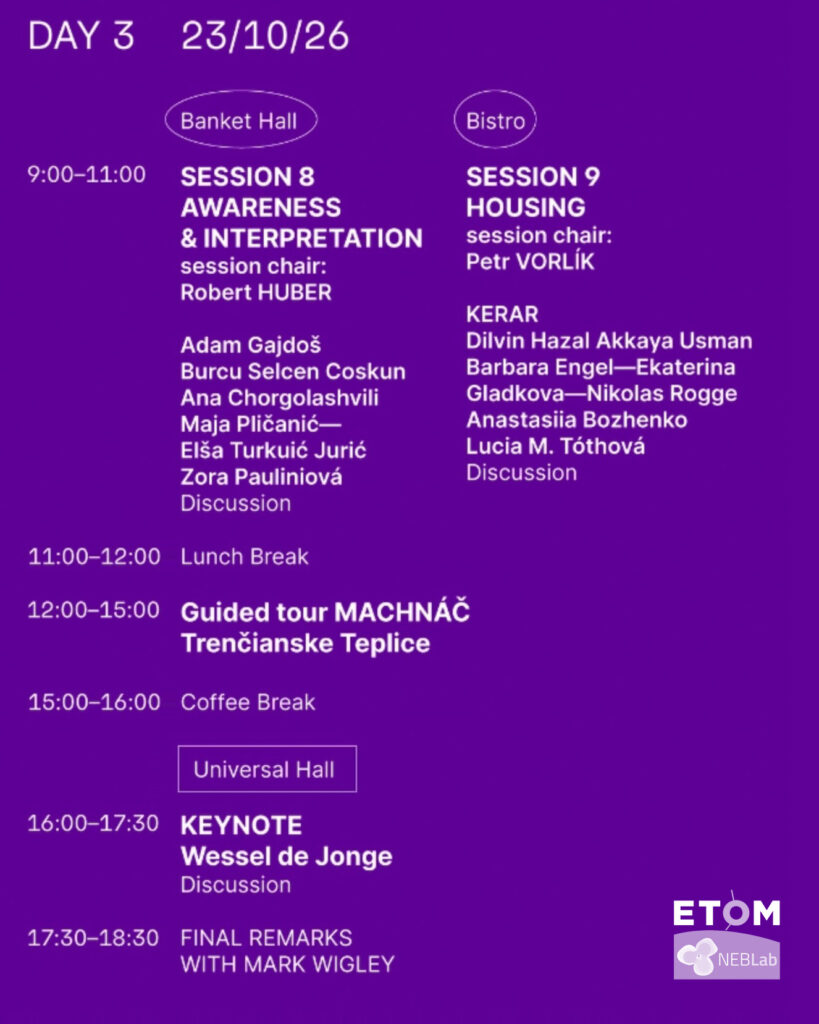
DAY 3 – 23/10/26
- 09:00–11:00: S2 – AWARENESS & INTERPRETATION (Banket Hall)
session chair: Robert HUBER- Adam Gajdoš: Beyond the Icons: How Post–war Modernism Was Selected, Framed, and Remembered
- Burcu Selcen Coşkun: Educating for Modern Movement Heritage: Pedagogy, Typology, and Strategy in the Conservation of Türkiye’s Recent Past
- Ana Chorgolashvili: Studying the City: Interdisciplinary Research, Education, and Practice
- Maja Pličanić, Elša Turkuić Jurić: Modernism in the Post–Industrial Landscape: Education as a Strategy of Transformation
- Zora Pauliniová: Planning for People or With People? Modernism and Participatory Planning
- Discussion
- 09:00–11:00: TY2 – HOUSING (Bistro)
session chair: Petr VORLÍK- Hamza Kerar: Reactivating Post–War Modernist Housing through Incremental Renovation: The Sixte Isnard Residential Complex in Avignon
- Dilvin Hazal Akkaya Usman: Lost Heritage and Urban Transformation: A Comparative Study of Seyfi Arkan’s „Güzel Konutlar“ and its Contemporary Replacement
- Barbara Engel, Ekaterina Gladkova, Nikolas Rogge: Open spaces in large housing estates. Typologies and Transformation in the Green Superblock in Tbilisi
- Anastasiia Bozhenko: Planning Saltivka: Standardization and the Organization of Everyday Life
- Lucia M. Tóthová: Housing in the 1950s in former Czechoslovakia: reflection and current state. Case study of the Trenčín Region
- Discussion
- 11:00–12:00 Lunch Break
- 12:00–15:00 SANATORIUM MACHNÁČ – GUIDED TOUR, TRENČIANSKE TEPLICE
- 15:00–16:00 Coffee Break
- 16:00–17:00 #3 HLAVNÁ PREDNÁŠKA / KEYNOTE LECTURE
- WESSEL DE JONGE: Heritage Strategies for Modern Movement Buildings. The pioneering case of Sanatorium Zonnestraal (1928–31)
- 17:00–17:30 Discussion
- 17:30–18:30 GRANDE FINALE with Mark WIGLEY and the Keynote Speakers
- Final Discussion & Remarks
Details and Updates
Registration
NOTES
The organizers reserve the right to make changes to the program.
The International Scientific Conference Modernism Revisited, the milestone conference of the European Triennale of Modernism (ETOM), is part of the Moderna 2.0 project. It is organised by the Jaromír Krejcar Society and the European Triennale of Modernism (ETOM) – New European Bauhaus Laboratory Berlin, and forms part of the official Trenčín 2026 – European Capital of Culture programme.
The Moderna 2.0 project is financially supported by the Creative Institute Trenčín, the City of Trenčín, the Trenčín Self–Governing Region, the Ministry of Culture of the Slovak Republic, and the European Union.
Within the programme of
Trenčin – European Capital of Culture
The title European Capital of Culture is a prestigious award granted annually by the European Union to one or more cities with the aim of fostering cultural development, creativity, and international cooperation. Being proclaimed as a European Capital of Culture puts the spot on the cities cultural activities and point of interest. Taking up this opportunity, Trenčín 2026 aims to transform the city and the region through culture and cooperation with Europe. The scheduled events and cooperations are designed to build long-term relationships. The widespread program will feature exhibitions and events in unexpected places that allow visitors and the cities society to experience them differently than usual.
Call for Concepts and Registration
Deadline Schedule:
- Scholarly papers
- Practice-based presentations
- Case studies (successful or unsuccessful transformations)
- Comparative or cross-regional analyses
- Theoretical, conceptual or other relevant reflections
Possible Formats:
- 02 December 2025 — Open Call for Abstracts
- 09 February 2026 — Call for Abstracts deadline
- 30 April 2026 — 1st version of the final Paper submission deadline
- 15 June 2026 — 2nd final version of the paper submission deadline
- 21–23 October 2026 — Conference in Trenčin
Stay tuned via Social Media

About ETOM

Partners of the ETOM-Initiative:
Initiated by
• BHROX bauhaus reuse / zukunftsgeraeusche GbR (zkg), Robert K. Huber, Berlin
• buschfeld.com / Ben Buschfeld (BB), Berlin
Development supported by
• Landesdenkmalamt Berlin (LDA)
• Bundesministerium für Wohnen, Stadtentwicklung und Bauwesen (BMWSB)
German Partners
• Landesdenkmalamt Berlin (LDA)
• Architektenkammer Berlin (AKB)
• Kunstbibliothek Berlin (KUBI)
• since 2025: Tschechisches Zentrum Berlin (TZB)
Members of the Coordination Group
• BHROX bauhaus reuse / zukunftsgeraeusche GbR (zkg), Berlin
• buschfeld.com, Berlin
• The Hungarian Contemporary Architecture Centre (KÉK), Budapest
• ICOMOS International Secretariat, Paris
• Estonian Academy of Arts – Institute of Art History and Visual Culture (EAA–EKA), Tallinn
• Contineo 2020 (CONTINEO), Skopje
Partners, Context and Funding